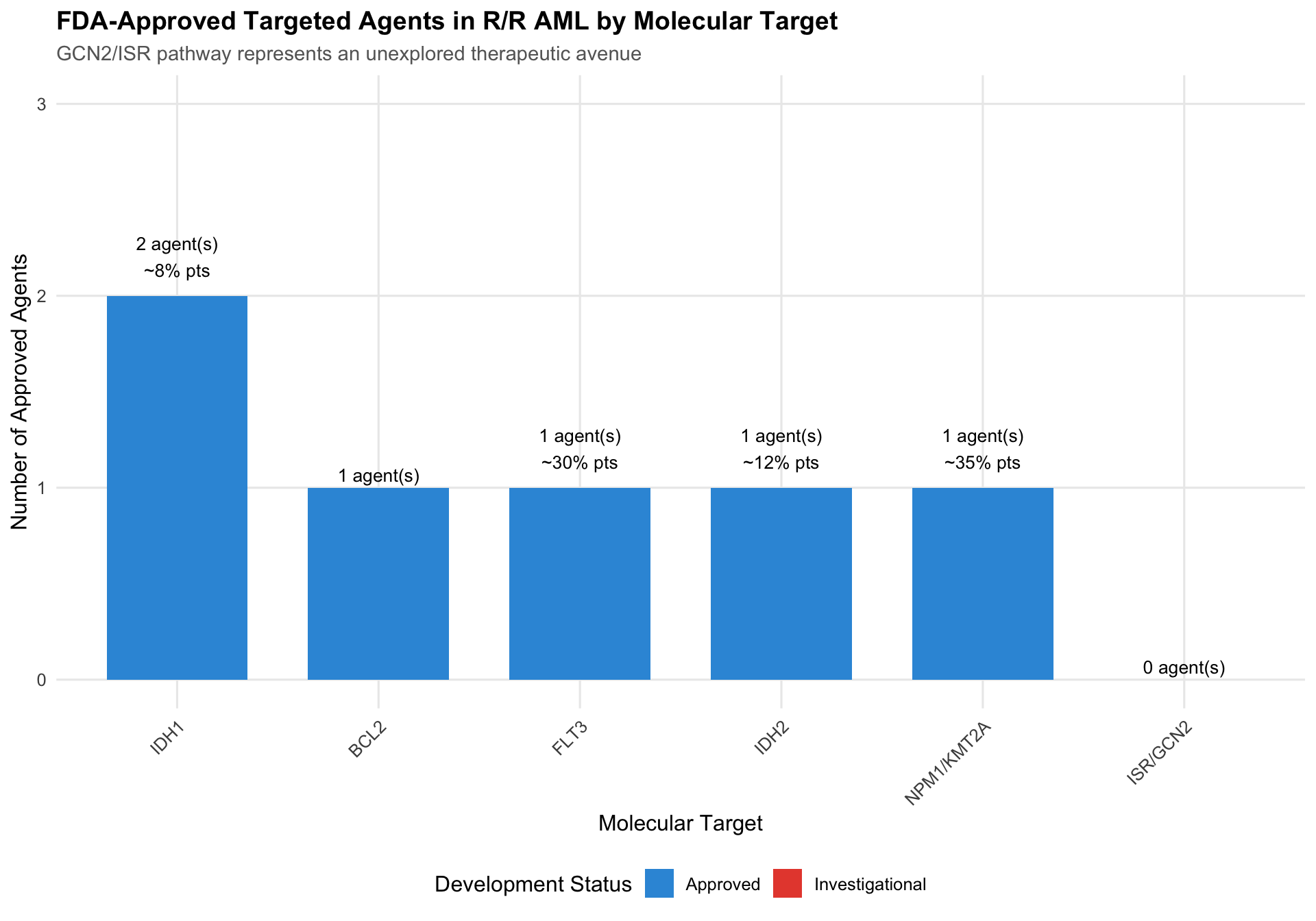
12 HC-7366 in the Therapeutic Landscape of Relapsed/Refractory AML
A Comprehensive Comparison with Existing Targeted Therapies
13 Executive Summary
HC-7366 represents a first-in-class therapeutic approach for relapsed/refractory acute myeloid leukemia (R/R AML) through targeted activation of the GCN2 kinase, a key component of the integrated stress response (ISR). This document provides a comprehensive comparison of HC-7366 with currently approved and investigational targeted therapies in R/R AML.
NoteKey Points
- HC-7366 is a first-in-class GCN2 kinase activator with FDA Fast Track designation
- Currently in Phase 1b clinical development in combination with venetoclax + azacitidine
- Unlike other targeted therapies, HC-7366 is mutation-agnostic and targets metabolic stress pathways
- The ISR pathway represents a novel therapeutic axis distinct from existing approaches
14 Introduction
14.1 Unmet Need in R/R AML
Relapsed or refractory AML remains one of the most challenging hematologic malignancies to treat. Despite recent advances in targeted therapy, outcomes remain poor for patients who fail initial therapy.
14.2 HC-7366: A Novel Mechanism of Action
HC-7366 is a first-in-class, selective, potent small-molecule activator of the General Control Nonderepressible 2 (GCN2) kinase. GCN2 is a key metabolic stress sensor within the integrated stress response (ISR) family.
14.2.1 Mechanism of Action
| HC-7366: Mechanism of Action | |
| Novel ISR-targeting therapeutic approach | |
| Feature | Description |
|---|---|
| Target | GCN2 kinase (EIF2AK4) |
| Mechanism | Hyperactivation of integrated stress response (ISR) |
| Downstream Effects | eIF2α phosphorylation, ATF4 activation |
| Anti-tumor Activity | Lethal ISR activation, translation inhibition, mitochondrial dysfunction |
| Immunomodulation | Disruption of immunosuppressive microenvironment |
| Selectivity | First-in-class, selective GCN2 activator |
15 Comparison of Targeted Therapies in R/R AML
15.1 FDA-Approved Agents
| FDA-Approved Targeted Agents for R/R AML | |||||||
| Comparison of efficacy and safety profiles | |||||||
| Agent | Drug Class | Molecular Target | FDA Indication | Approval Year | CR/CRh Rate1 | mOS (months)2 | Key Adverse Events |
|---|---|---|---|---|---|---|---|
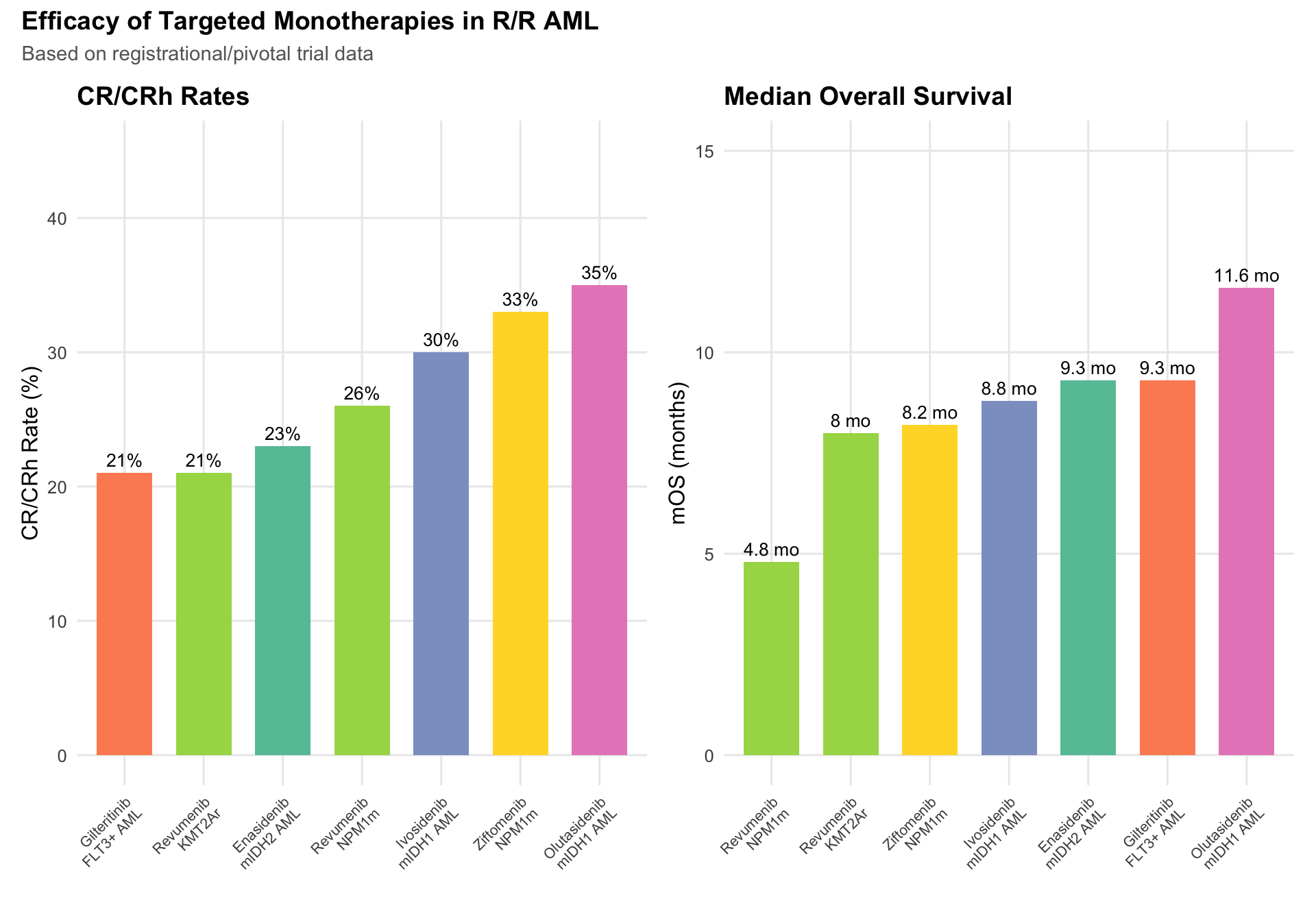
| Gilteritinib | FLT3 inhibitor | FLT3-ITD/TKD | R/R FLT3+ AML | 2018 | 21% | 9.3 | AST/ALT elevation, myalgia, fatigue |
| Ivosidenib | IDH1 inhibitor | Mutant IDH1 | R/R mIDH1 AML | 2018 | 30% | 8.8 | QTc prolongation, differentiation syndrome |
| Olutasidenib | IDH1 inhibitor | Mutant IDH1 | R/R mIDH1 AML | 2022 | 35% | 11.6 | Hepatotoxicity, differentiation syndrome |
| Enasidenib | IDH2 inhibitor | Mutant IDH2 | R/R mIDH2 AML | 2017 | 23% | 9.3 | Hyperbilirubinemia, differentiation syndrome |
| Revumenib | Menin inhibitor | Menin-KMT2A | R/R KMT2Ar/NPM1m | 2024 | 21-23% | 8.0 | QTc prolongation, differentiation syndrome |
| 1 CR/CRh = Complete Remission + CR with partial hematologic recovery | |||||||
| 2 mOS = median Overall Survival | |||||||
15.2 Investigational Menin Inhibitors
| Menin Inhibitors in R/R AML: Clinical Trial Comparisons | |||||||||
| Monotherapy efficacy data from published trials | |||||||||
| Agent | Sponsor | Study | Phase | Population | N | ORR | CR/CRh | mDoR (mo) | Status |
|---|---|---|---|---|---|---|---|---|---|
| Revumenib | Syndax | AUGMENT-101 | 2 | R/R KMT2Ar | 104 | 63% | 21% | 6.4 | FDA Approved |
| Revumenib | Syndax | AUGMENT-101 | 2 | R/R NPM1m | 77 | 48% | 26% | 4.7 | FDA Approved |
| Ziftomenib | Kura | KOMET-001 | 1 | R/R NPM1m | 92 | 45% | 33% | 3.7 | Phase 2 ongoing |
| Bleximenib | J&J | 75276617/ALE1001 | 1 | R/R KMT2Ar/NPM1m | 125 | 46-63% | 21-48% | NR | Phase 3 initiated |
| Enzomenib | Sumitomo | NCT04988555 | 1 | R/R NPM1m/KMT2Ar | 40 | 59-65% | 47-63% | 7.0 | Phase 1 ongoing |
16 HC-7366 Clinical Development
16.1 Phase 1b Trial Design (NCT06285890)
| HC-7366 Phase 1b Trial Design | |
| Combination with venetoclax and azacitidine in R/R AML | |
| Parameter | Details |
|---|---|
| Trial ID | NCT06285890 |
| Phase | 1b |
| Sponsor | HiberCell, Inc. |
| Study Site | MD Anderson Cancer Center |
| Study Initiation | May 20, 2024 |
| Estimated Completion | December 31, 2029 |
| Target Enrollment | ~18 patients |
| Population | R/R AML or MDS-AML (10-19% blasts) |
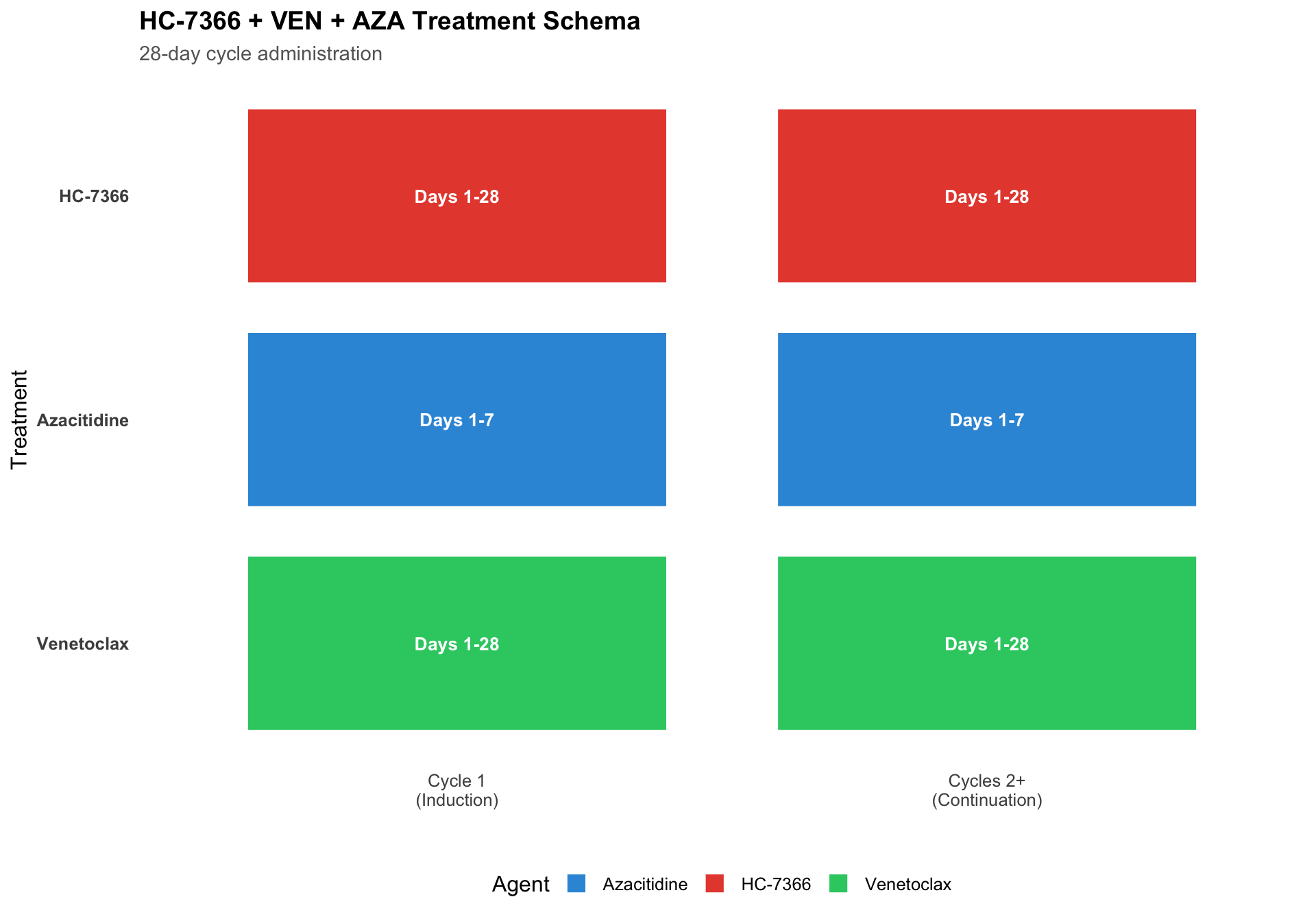
| Treatment | HC-7366 + Venetoclax + Azacitidine |
| Primary Endpoint | Safety, tolerability, RP2D determination |
| Secondary Endpoints | CR/CRc rates, ORR, MRD negativity, OS, RFS |
16.2 Treatment Schema
17 Comparative Analysis
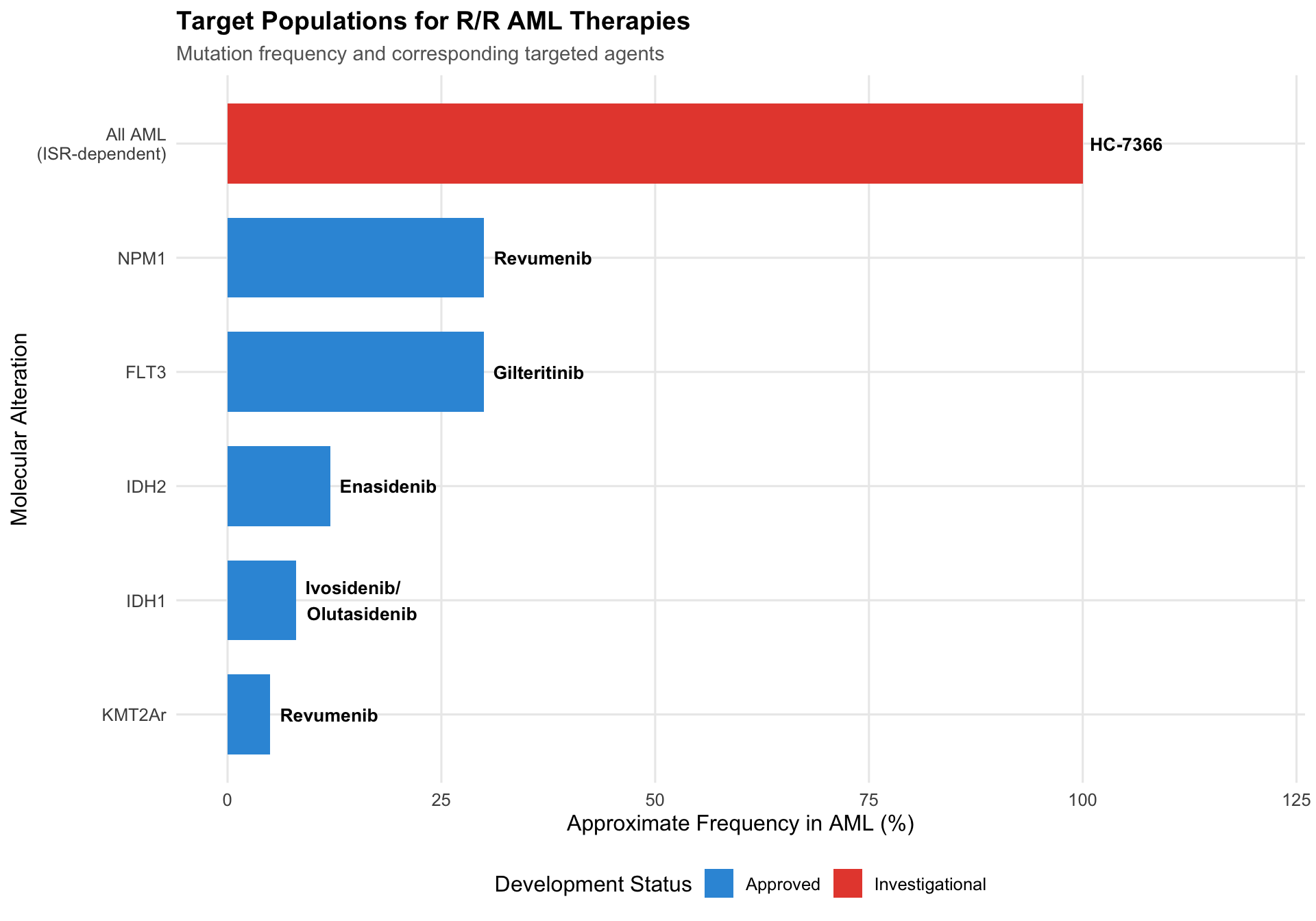
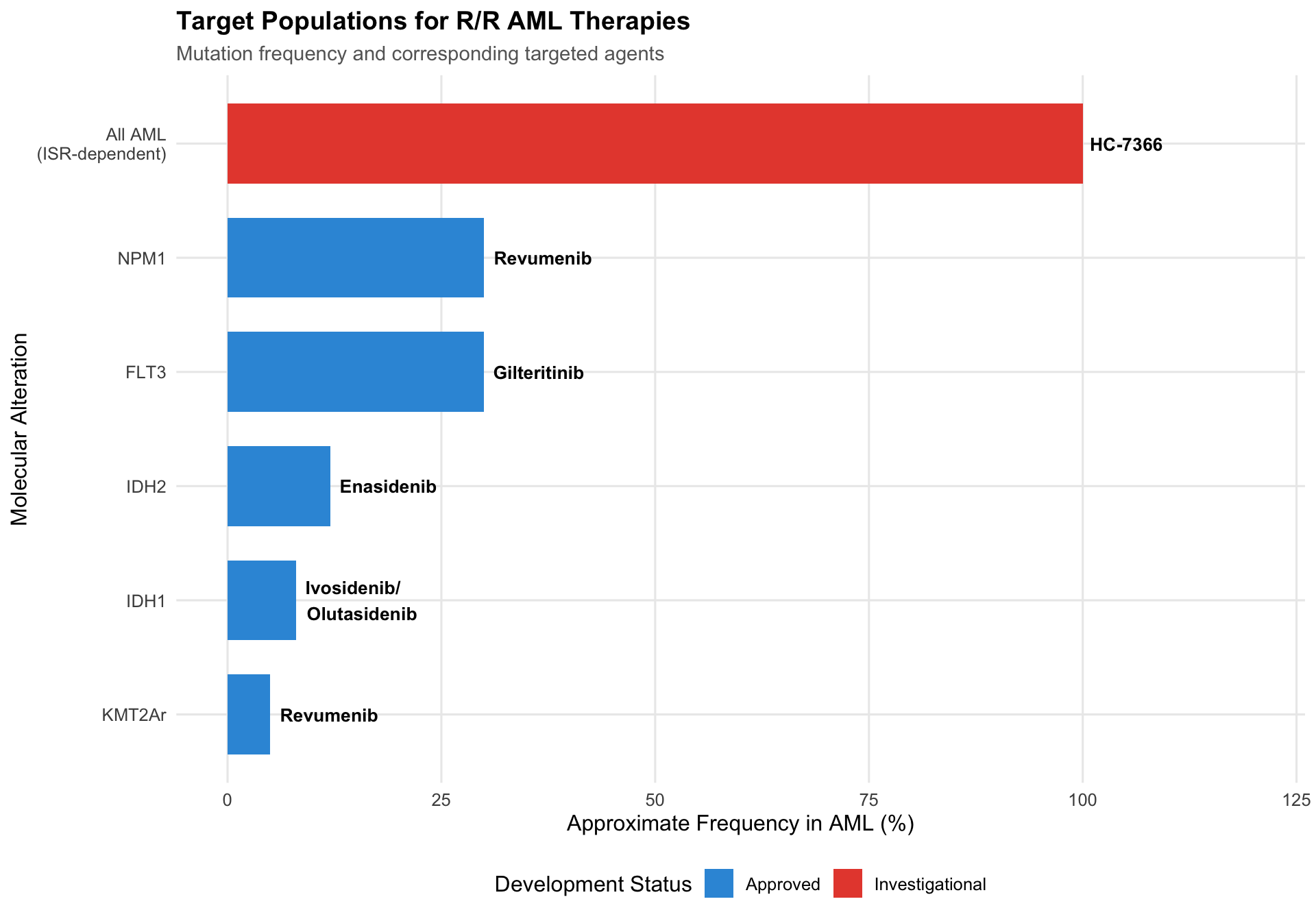
17.1 Target Population and Mutation Landscape
17.2 Efficacy Comparison
17.3 Safety Profile Comparison
| Safety Profile Comparison of R/R AML Targeted Therapies | |||||
| Key adverse events of clinical significance | |||||
| Agent | QTc Prolongation | Diff. Syndrome | Hepatotoxicity | Cytopenias | GI Toxicity |
|---|---|---|---|---|---|
| HC-7366 | Unknown | Unknown | Unknown | Expected | Expected |
| Revumenib | 43% | 19% | Low | High | Moderate |
| Ziftomenib | 2% | 13% | Low | High | Moderate |
| Bleximenib | None | 6% | Low | High | Moderate |
| Gilteritinib | 5% | 3% | Moderate | Moderate | High |
| Ivosidenib | 24% | 11% | Low | Moderate | Moderate |
| Olutasidenib | Low | 7% | High | Moderate | Moderate |
| Enasidenib | Low | 14% | Low | Moderate | Moderate |
18 Combination Therapy Strategies
18.1 Triplet Regimens in Development
| Triplet Combination Regimens in AML | |||||||
| Menin inhibitor or ISR modulator + HMA + Venetoclax | |||||||
| Regimen | Trial | Phase | Population | N | CRc Rate | MRD Neg | Status |
|---|---|---|---|---|---|---|---|
| Aza + Ven + Revumenib | BEAT-AML | 1b | ND NPM1m/KMT2Ar | 43 | 81% | 100% | Phase 3 planned |
| Aza + Ven + Ziftomenib | KOMET-007 | 1b | R/R NPM1m/KMT2Ar | 22 | 38% | NR | Ongoing |
| Aza + Ven + Bleximenib | cAMeLot | 1b | ND/R/R NPM1m/KMT2Ar | 125 | 59-75% | NR | Phase 3 initiated |
| Aza + Ven + HC-7366 | NCT06285890 | 1b | R/R AML/MDS-AML | 18 | Pending | Pending | Enrolling |
| Dec/Ced + Ven + Revumenib | SAVE | 1/2 | R/R NPM1m/KMT2Ar | 50 | 60% | NR | Ongoing |
18.2 Rationale for HC-7366 Combinations
| Mechanistic Rationale for Triple Combination | |||
| Complementary mechanisms targeting AML cell survival | |||
| Agent | Primary Target | Cellular Effect | Combination Benefit |
|---|---|---|---|
| Venetoclax | BCL-2 inhibition | Apoptosis induction | Primes cells for apoptosis |
| Azacitidine | DNA hypomethylation | Gene re-expression | Enhances differentiation |
| HC-7366 | ISR hyperactivation | Metabolic stress | Disrupts survival pathways |
Scientific Rationale for HC-7366 Combination with Venetoclax and Azacitidine
19 Differentiation from Existing Therapies
19.1 Unique Positioning of HC-7366
| Differentiation of HC-7366 from Existing R/R AML Therapies | ||||
| Key distinguishing features | ||||
| Feature | HC-7366 |
Existing Targeted Therapies
|
||
|---|---|---|---|---|
| Menin Inhibitors | FLT3 Inhibitors | IDH Inhibitors | ||
| Mechanism | ISR activation | Menin-KMT2A disruption | Kinase inhibition | Metabolite normalization |
| Target Population | Broad (mutation-agnostic) | NPM1m, KMT2Ar (~35%) | FLT3+ (~30%) | IDH1/2+ (~20%) |
| Novel Target | Yes (first-in-class) | Yes (first-in-class) | No | No |
| Combination Strategy | Ven + HMA | Ven + HMA | Chemo or Ven + HMA | HMA ± Ven |
| Differentiation Syndrome | Unknown | Yes (10-20%) | Rare | Yes (7-14%) |
| QTc Prolongation | Unknown | Yes (2-43%) | Low | Yes (ivosidenib) |
| Resistance Mechanism | Unknown | MEN1 mutations | On-target mutations | Second-site mutations |
20 Future Directions
20.1 Development Pathway for HC-7366
20.2 Key Questions to Address
ImportantOutstanding Questions for HC-7366 Development
- Efficacy: What are the CR/CRh rates and durability of response with HC-7366 + Ven + Aza?
- Safety: What is the toxicity profile, particularly regarding differentiation syndrome?
- Biomarkers: Are there predictive biomarkers for response beyond mutation status?
- Resistance: What are the mechanisms of resistance to GCN2 activation?
- Combinations: What is the optimal sequencing with other targeted agents?
21 Conclusions
| Summary: HC-7366 in the R/R AML Landscape | |
| Aspect | Summary |
|---|---|
| Novelty | HC-7366 represents a first-in-class approach targeting the ISR/GCN2 pathway |
| Differentiation | Unlike existing therapies, HC-7366 is mutation-agnostic and may have broader applicability |
| Development Stage | Early Phase 1b; efficacy data pending |
| Competitive Landscape | Enters a rapidly evolving field with menin inhibitors gaining momentum |
| Potential Advantages | Novel mechanism may overcome resistance to existing targeted therapies |
| Key Risks | Unproven efficacy in humans; safety profile unknown; competitive pressure from menin inhibitors |
22 References
22.1 Key Clinical Trial References
- HiberCell Phase 1b Trial (NCT06285890): HC-7366 + Venetoclax + Azacitidine in R/R AML
- AUGMENT-101 (NCT04065399): Revumenib in R/R KMT2Ar/NPM1m acute leukemia
- KOMET-001 (NCT04067336): Ziftomenib in R/R AML
- BEAT-AML (NCT03013998): Azacitidine + Venetoclax + Revumenib in ND AML
- ADMIRAL (NCT02421939): Gilteritinib vs salvage chemotherapy in R/R FLT3+ AML
22.2 FDA Approval References
- Gilteritinib: FDA approval November 28, 2018
- Ivosidenib: FDA approval July 20, 2018
- Olutasidenib: FDA approval December 1, 2022
- Enasidenib: FDA approval August 1, 2017
- Revumenib: FDA approval November 15, 2024 (KMT2Ar), October 24, 2025 (NPM1m)
Document prepared: 2026-08-19
Data sources: ClinicalTrials.gov, FDA.gov, published clinical trial data, company press releases